
Suspension
Worn suspension bushes: what it means and what to do
A “worn suspension arm pin or bush” entry means the tester found wear at a suspension joint or mounting. An advisory is below the failure threshold; a major defect is a fail. If you're buying the car, the question is what has happened since that finding—not simply whether it appears in the history.
What it actually means
The suspension arm is the metal part that helps keep the wheel in position as it moves up and down. The bush is a smaller, flexible mounting where the arm connects to the car. It cushions movement and vibration.
When the rubber deteriorates, it can separate from its metal sleeve or housing. That does not automatically mean the metal arm needs replacing. The repair depends on the part's condition and whether its bush can be changed separately.
The MOT wording covers several types of joint and mounting. Ask the garage to identify the exact part and side before getting a quote; the code alone isn't a parts list.
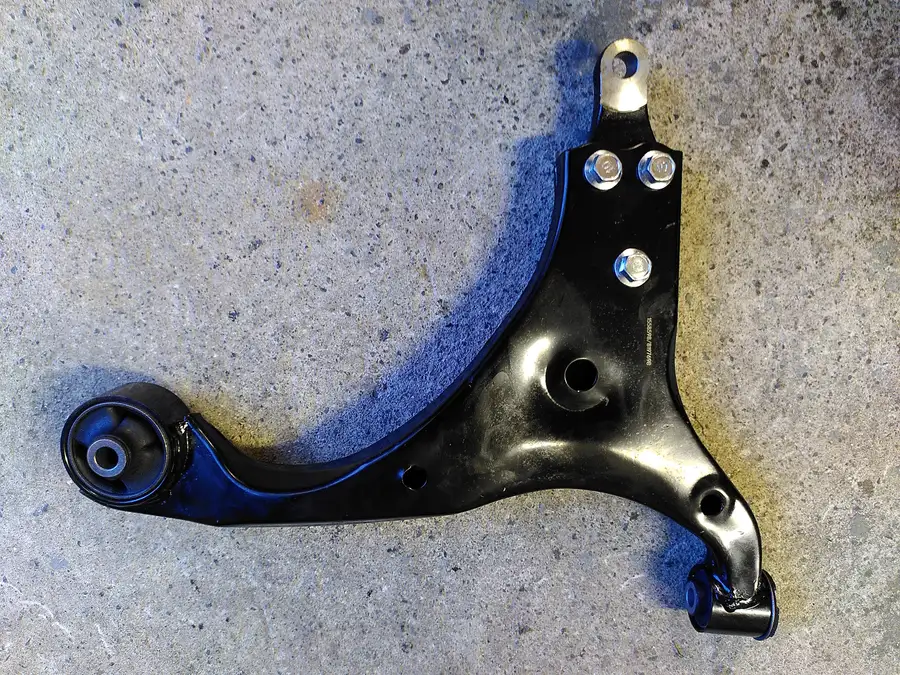
Where the bush fits: the rubber mount is part of the larger suspension arm. This identifies the part; it is not a worn-bush example.
Photo: Track control arm for a Kia Ceed 02 — So9q / Wikimedia Commons · CC BY-SA 4.0. Converted for display. Arrow annotation by Lemoned, shared under the same licence.

Why it happened
Bushes flex as you brake, turn and drive over bumps. Repeated movement puts the rubber under strain, and over time it can deteriorate or pull away from the metal it's bonded to.
This can happen through ordinary use. A worn bush on an MOT is not, by itself, evidence that the car has been abused. The entry records the wear the tester found, not its cause or how long it took to develop.
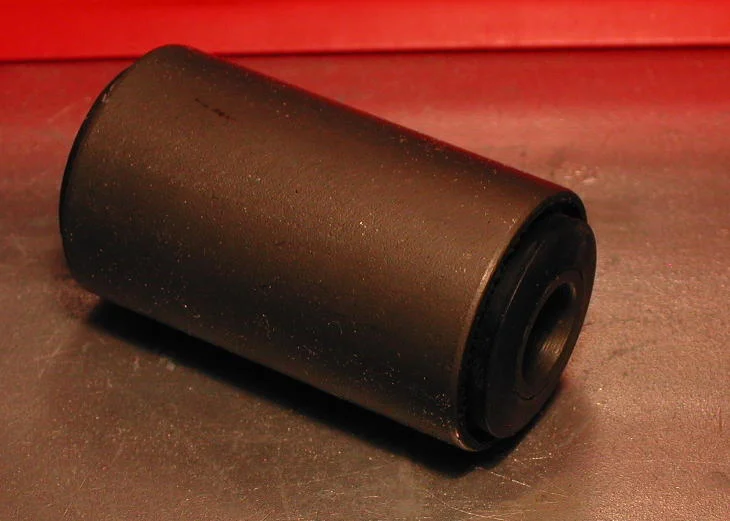
Intact rubber example. The visible rubber remains continuous around the sleeve.
Photo: Cav / Wikimedia Commons · Public domain. Converted for display.


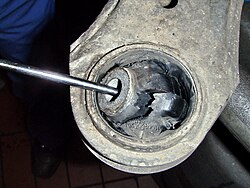
Worn control-arm bush. The rubber has torn and separated around the centre sleeve.
Photo: Johann H. Addicks / Wikimedia Commons · Public domain (250px thumbnail). Converted for display.


Different bush designs, not a before-and-after pair.
What it costs
Budget roughly £90 to £180 at an independent garage for a pair of front bushes on an ordinary hatchback, going up to £300 or so on a van or a car where the bush isn't sold separately and the whole arm has to come off. Labour is most of the bill: some cars are an hour, some are most of a morning. Online estimate guides will give you a figure for your model, but the only number worth negotiating with is a written quote. Ask two things: is that a bush, a joint or the whole arm, and does it include alignment?
If you're buying the car
Start with: “What was done about this entry, and do you have the invoice?”
If the seller says it was repaired, match the invoice to the component, side and date in the MOT history. Work on the offside doesn't account for a nearside finding. A vague “suspension repair” description may need explaining.
If the entry keeps returning and there's no paperwork, ask for an inspection and written quote before negotiating. You need to know what needs doing now, rather than guessing a discount from an old MOT line.
If an advisory became a major failure, look at the next recorded test too. A later pass is evidence of meeting the test standard on that date, but it doesn't tell you which parts were changed. Ask for the repair record between those tests.
If the seller cannot account for an outstanding failure, pause the purchase until it has been independently assessed. A lower price doesn't resolve the unanswered question.
The MOT wording in full
Section 5.3.4 of the DVSA manual covers suspension pins, bushes, joints and bearings. The recorded position identifies which part of the car was affected.
| What you'll see | What it means |
|---|---|
| Advisory: worn but not resulting in excessive movement | Below the failure threshold for this item. Monitor and repair if necessary. Another item may still have failed. |
| Major: excessively worn | The car failed that test. Repair immediately. |
| Dangerous: likely to become detached | The car failed. Do not drive it until the fault is repaired. |
| PRS: pass after rectification at station | A failed item was rectified at the station within one hour of completing the test, with the defect and subsequent pass recorded. |
PRS is a test outcome, not another level of severity. Rubber bushes are designed to flex, so movement alone is not automatically a failure.
These are Great Britain rules. Northern Ireland uses a separate DVA inspection manual.
What this page can't tell you
An entry disappearing doesn't prove a repair, and repeated entries don't prove that no work was done between tests. The history cannot establish the part's condition today.
This guide has not been reviewed by a mechanic. It explains the records; it does not diagnose the car, confirm it is safe to drive or replace an inspection.
Next
Check the car's MOT history and keep the relevant entry to hand when you speak to the seller.
Sources and checks
Price reference
Bush-replacement estimate guides describe specific jobs, not a fixed tariff for every car. Check the quantity and repair scope, and confirm the fitted total including VAT with the garage.
- MOT wording and thresholds: DVSA inspection manual, 5.3.4.
- Outcome instructions and PRS: DVSA defect categories and MOT testing guide, B5.
- Bush function and wear: A component manufacturer's bush explanation and rubber-separation bulletin.
- Repair scope and price factors: Bush-replacement service information.
- Northern Ireland: DVA light-vehicle inspection manual.
Found an error? Email hello@lemoned.co.uk with the passage and supporting source.