
Suspension
Ball-joint dust cover damage: what it means and what to do
What it means
Your MOT history mentions a dust cover, or a boot, on a suspension joint. That's the small rubber cover around a ball joint — a pivot that allows movement between the wheel assembly and suspension. The boot's job is to hold grease in and keep road salt, grit and water out.
When it splits, perishes or goes missing, the joint inside loses its protection. The MOT entry is about the cover, not the joint. Those are two separate questions, and they're worth asking a garage separately: does the cover need replacing, and is the joint underneath actually worn? A split boot can lead to corrosion and wear inside the joint over time, but the entry itself doesn't say that has happened. The cover protects the moving joint; component makers describe how the two relate.
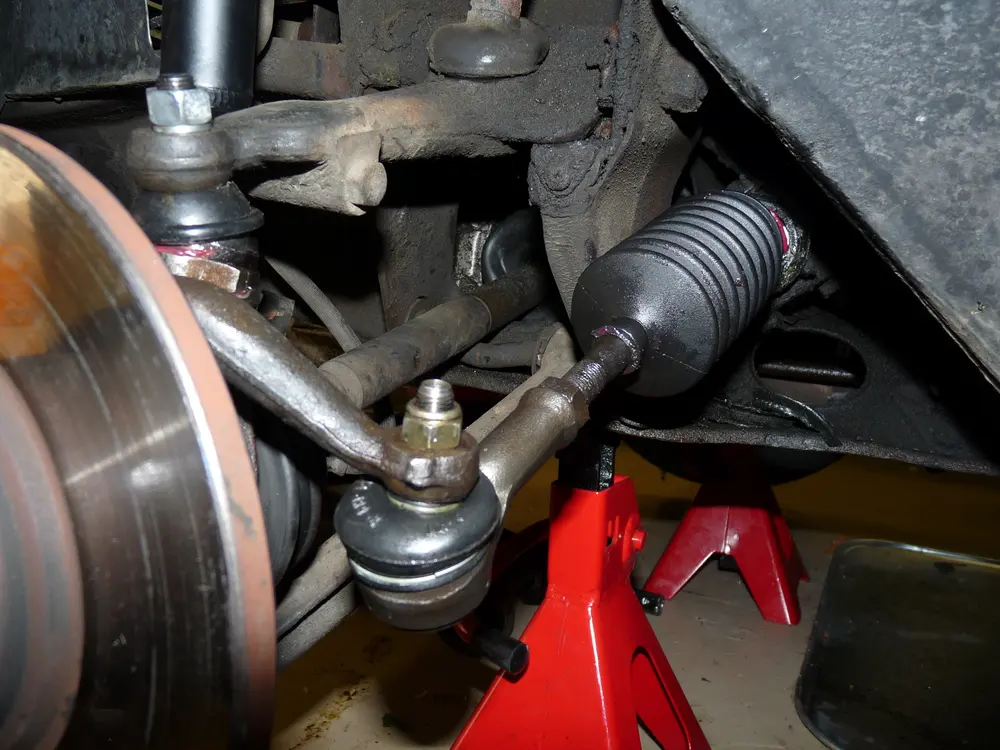
Where the cover fits. The arrow marks the suspension ball-joint dust cover. It appears intact in this photo; the joint itself still needs a separate wear check.
Photo: Craig Howell / Wikimedia Commons · CC BY 2.0. Converted for display. Arrow annotation by Lemoned, shared under the same licence.

Why it happened
The cover can deteriorate or get damaged. It can also fail early if it twists as the joint moves, or if the rubber is nicked during fitting.
One thing a photo can't settle: a visibly split cover tells you the cover has gone, not how much wear is inside the joint. An intact-looking boot isn't proof of a healthy joint either. Ask a garage to check the joint itself.
What it costs
If the joint has to be replaced, expect somewhere between £60 and £150 a corner on a common car, more on something bigger or where the joint comes as part of the arm. A boot-only repair is cheaper where it's possible at all — plenty of modern joints are sealed units and can't be re-booted, which is worth asking before you assume it's a small job.
If you're buying the car
Ask which joint, and which side. An anti-roll-bar link and a suspension-arm ball joint both have boots and both appear with the same manual reference. They're different parts and different money.
Ask whether the cover still seals, and whether the joint's been checked for wear. Two questions, two answers.
If it's been repaired, get the invoice and check it names the cover, the joint or the arm — whichever was actually replaced.
Don't take "it passed" as the whole answer. A car can pass with a minor dust-cover defect recorded against it. The pass and the defect can both be true.
The MOT wording
DVSA's section 5.3.4(b) treats the cover's condition separately from wear in the joint.
| What you'll see | What it means |
|---|---|
| Minor: severely deteriorated | This item alone does not fail the MOT. Repair as soon as possible. |
| Major: missing, or no longer keeping dirt out | Failed. Repair immediately. |
| PRS | Failed, then put right while still at the station within one hour after the test was completed, so the defect and a pass are both recorded. Ask what was done. |
There's no dangerous category for the dust cover itself. The joint inside it can have its own, more serious finding. Sources: DVSA's category instructions and the MOT testing guide.
These are the Great Britain categories; Northern Ireland runs under the DVA's manual.
What this page can't tell you
It can't tell you whether only the cover needs doing — that takes a look at the car. And if the entry disappears from a later test, that doesn't identify what was repaired, only that the tester didn't record it that day. This is a guide to the record, not a diagnosis, and it hasn't been reviewed by a mechanic.
Next
Check a car with Lemoned to see which joint and which side were recorded, and when. If the entry names a suspension arm pin or bush rather than its cover, read suspension pins and bushes instead.
Spotted an error? Email hello@lemoned.co.uk with the passage and the source that contradicts it.